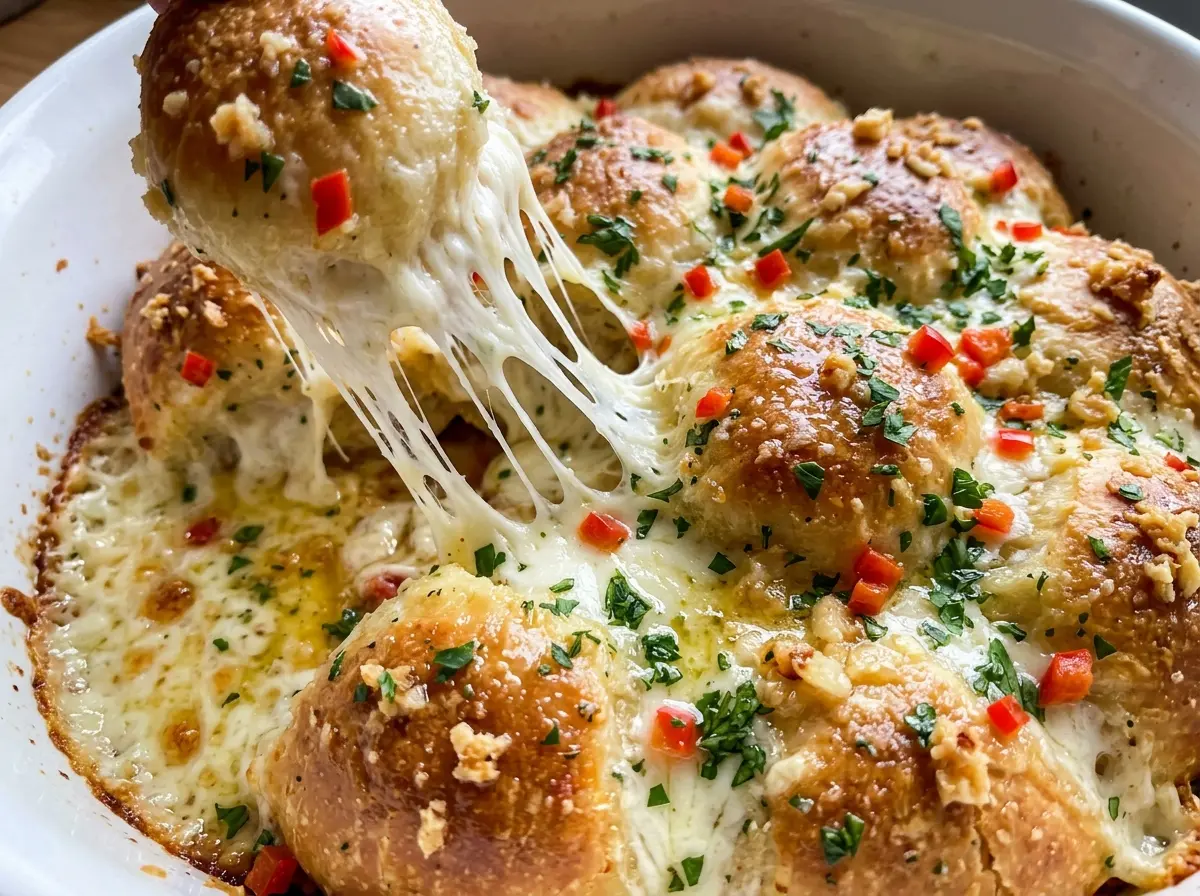
The yeast mixture tells you early whether the dough is off to a good start: after a few minutes, it should look foamy, not flat. Once the dough rises, each piece wraps around mozzarella and bakes into a soft roll you can pull apart. I make this Cheesy Pull Apart Christmas Bread in two rings on a sheet pan, so it has a wreath shape without needing a special pan.
The dough is enriched with egg and softened butter, which gives the rolls a tender, pillowy bite. Low-moisture mozzarella keeps the centers cheesy without bringing extra moisture into the dough. A quick garlic-herb oil goes on after baking, while the rolls are still hot, so the parsley and red pepper cling to the golden tops.
It’s a festive centerpiece, but it’s also practical: the dough portions are easy to share, and the wreath can go straight from the pan to the table. Tear into a warm roll and you’ll find a stretchy mozzarella center under that garlicky, herb-flecked crust.
Kitchen Note
Keep the garlic pale while it warms in the oil. If it starts to brown, it can turn bitter, so stay close and take the skillet off the heat before stirring in the parsley and red pepper.
Save this Cheesy Pull Apart Christmas Bread for its golden wreath shape, mozzarella-filled rolls, and garlic-herb finish.
Why the Center Opening Makes This Wreath Easier to Shape
A round wreath is easy to recognize, but a bare circle marked on parchment is less helpful once you’re arranging soft dough. The ramekin gives you a fixed center point, so the two rings have a clear boundary as you place the rolls. It also leaves the center open rather than letting the dough crowd inward as it rises.
Even portions matter here for more than appearance. When the dough pieces are close in size, the rolls bake at a similar pace, and each one gets a comparable amount of mozzarella. Keep the seams tucked underneath as you arrange them; that gives the wreath a smooth top and keeps the joined edges from interrupting the shape. The ramekin is only a shaping guide, not part of the bake, so the finished bread has a clean opening in the middle and golden rolls all around it.
What Gives the Dough Its Soft Pull and the Filling Its Stretch

- Whole milk, yeast, and sugar — Warm milk helps activate the active dry yeast, and the sugar supports that first rise. Whole milk gives the dough a richer, softer crumb; 2% milk works in the same quantity, though the rolls will be a little less rich. Use a thermometer to check the milk rather than guessing by touch.
- Egg, all-purpose flour, salt, and butter — The egg and butter make this a tender, enriched dough, while all-purpose flour keeps the rolls soft rather than especially chewy. Room-temperature egg blends in more easily. Bread flour can be used in the same quantity if you prefer a chewier bite, but don’t switch to self-rising flour because it changes the salt and leavening balance.
- Low-moisture mozzarella — This is the cheese to buy when you want a stretchy center without adding the excess moisture that fresh mozzarella carries. A block is convenient to cut into pieces. Low-moisture provolone also works in the same quantity, cut into 24 pieces; it gives the filling a slightly sharper, more savory taste.
- Olive oil, garlic, parsley, and red bell pepper — The oil carries the garlic and fresh herbs over the surface, and finely grated garlic spreads more evenly than a rough chop. Fresh parsley tastes brighter than dried in this quick finish. Choose a firm red pepper and dice it finely so the little pieces stay on the rolls instead of sliding off.
From Foamy Yeast to a Golden, Cheese-Filled Wreath
Activate the Yeast and Mix the Dough
Warm the milk to 105–110°F, then stir it with the sugar and active dry yeast in a large bowl. Let the mixture stand for 5–10 minutes, until a foamy layer forms on top. Whisk in the room-temperature egg, then stir in the flour and salt until no dry patches remain and a shaggy dough forms. If the surface stays flat rather than foamy, give the mixture a little more time before moving on.
Knead in the Butter and Let the Dough Rise
Add the softened butter a piece at a time, kneading until each piece is worked into the dough before adding the next. Turn the dough out onto a clean counter and knead for 8–10 minutes, until it feels smooth and elastic. Return it to the bowl, cover it, and leave it at room temperature for 1–1 1/2 hours, until doubled. The doubled size is the cue to watch for, since a cool kitchen can slow the rise.
Wrap the Mozzarella and Arrange the Rings
Line an 18×13-inch rimmed baking sheet with parchment and set a 4-inch oven-safe ramekin upside down in the center as a guide. Divide the dough into 24 equal pieces and cut the low-moisture mozzarella into 24 pieces as well. Wrap one piece of cheese in each dough portion, pinch the seams closed, and set each piece seam-side down. Arrange the rolls in two rings around the ramekin, keeping the center opening clear.
Proof the Wreath and Bake Until Golden
Cover the shaped rolls loosely and let them rise for 30–45 minutes, until they look puffy. Heat the oven to 350°F during this rise. Lift away the ramekin before the pan goes into the oven. Bake for 25–30 minutes, until the bread is golden brown and the center rolls reach about 190°F.
Brush on the Garlic-Herb Oil
While the wreath bakes, warm the olive oil in a small skillet over low heat. Add the finely grated garlic and cook for 30 seconds, then take the skillet off the heat and stir in the parsley and diced red bell pepper. Brush the oil over the hot wreath as soon as it comes out of the oven. Let the bread rest on the pan for 10 minutes before serving, so the rolls settle and are easier to pull apart.
Cheese Swaps and a Dairy-Free Dough Option
Use Pepper Jack for a Little Heat
Replace the mozzarella with low-moisture pepper jack cut into 24 pieces. The rolls keep their cheesy centers, but the filling has a gentle kick and a less classic mozzarella pull.
Make the Dough Dairy-Free
Use unsweetened oat milk, unsalted dairy-free butter, and a block-style dairy-free mozzarella alternative in the same quantities. Cut the cheese alternative into 24 pieces. The rolls will still form a soft wreath, though plant-based cheese may melt less smoothly; this variation still contains egg, so it isn’t vegan.
Storage and Reheating
- Refrigerator: Store leftovers covered for 3–4 days. The bread will lose some of its just-baked softness as it chills.
- Freezer: Freeze the fully cooled bread in a tightly wrapped freezer-safe package for up to 2 months. Thaw it in the refrigerator before reheating.
- Reheating: Warm portions in a 300°F oven, loosely covered with foil, until heated through. The microwave is quick, but it can make the bread chewy and the cheese rubbery.
Questions That Come Up While Making This Cheese Wreath
Cheesy Pull Apart Christmas Bread
Ingredients
Equipment
Method
- Stir the milk, warmed to 105–110°F, with the sugar and yeast in a large bowl. Let stand for 5–10 minutes, until foamy.
- Whisk the egg into the yeast mixture, then stir in the flour and salt until a shaggy dough forms.
- Knead in the softened butter a piece at a time.
- Knead the dough on a clean counter for 8–10 minutes, until smooth and elastic.
- Return the dough to the bowl, cover, and let rise at room temperature for 1–1 1/2 hours, until doubled.
- Line an 18x13-inch rimmed baking sheet with parchment and set a 4-inch oven-safe ramekin upside down in the center as a guide.
- Divide the dough into 24 equal pieces.
- Wrap one piece of mozzarella in each piece of dough and pinch the seams closed.
- Arrange the dough balls seam-side down in two rings around the ramekin.
- Cover loosely and let rise for 30–45 minutes, until puffy, while heating the oven to 350°F.
- Lift away the ramekin and bake for 25–30 minutes, until the bread is golden brown and the center rolls reach about 190°F.
- While the bread bakes, warm the olive oil in a small skillet over low heat.
- Add the garlic and cook for 30 seconds without browning.
- Remove the skillet from the heat and stir in the parsley and red bell pepper.
- Brush the hot wreath with the garlic-herb oil.
- Let rest on the pan for 10 minutes before serving.