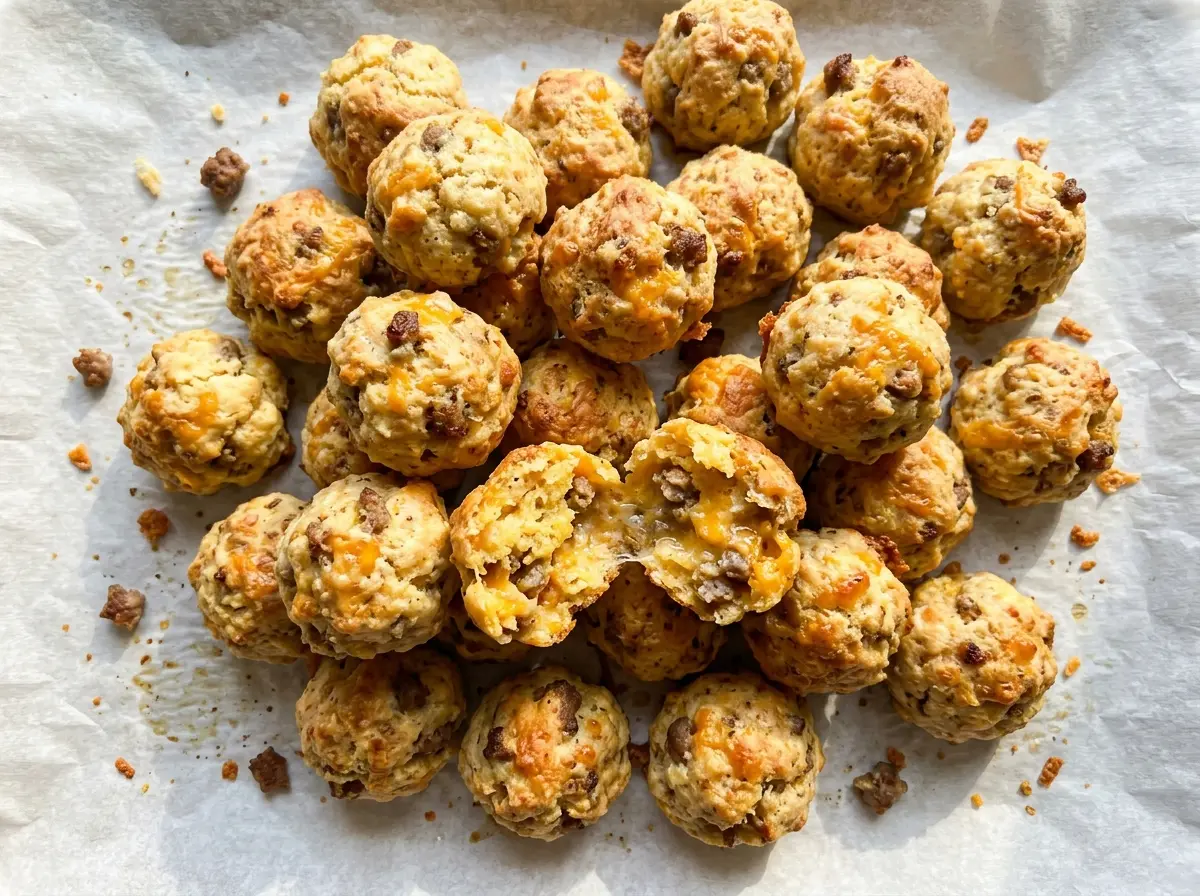
The bowl looks stubbornly crumbly when the sausage, cheddar, and baking mix first meet; it doesn’t resemble a dough you’d roll yet. I knead it with my hands until the dry pockets disappear and it presses together cleanly, then shape these Bisquick sausage balls into even rounds. They bake up golden, with savory sausage and sharp cheddar in every bite.
This is a simple mixture, but it rewards a little attention before the balls go onto the pan. The sausage and cheese need to be distributed through the baking mix so each bite holds together, and the finished balls need enough space to brown instead of crowding each other. The result is a tender, cheesy center under a lightly browned outside.
Kitchen Note
Let the bulk sausage soften slightly at room temperature before you start. Cold sausage is harder to work through the baking mix and cheese, so give it a little time before mixing.
Save these Bisquick sausage balls for an easy batch of golden, cheesy bites with a savory pork center.
Why the dough has to hold together before you roll a single ball
These sausage balls don’t have eggs or another separate binder. The mixture needs to be evenly worked so the sausage and cheddar help the baking mix form a dough that stays together when you shape it. If you start rolling while there are still dry pockets, those bits can crack or fall away, and the finished balls won’t have the same even texture.
Use your hands to knead the mixture through the bowl, turning and pressing it until the ingredients look evenly distributed and the dough holds together when squeezed. It may feel dense rather than soft and fluffy; that’s expected for a mixture built from baking mix, sausage, and cheese. Don’t add extra baking mix just because the dough starts out uneven. Keep working it until it comes together, then move on to shaping.
Once the dough is cohesive, portioning it into one-inch balls gives you a consistent size across the pan. Evenly sized pieces bake at a similar pace, while a mix of large and small balls can leave some centers underdone as others brown.
Why Bisquick, bulk sausage, and sharp cheddar make a sturdy bite

- Bisquick Original — It supplies the dry base and leavening in one ingredient, which is why plain flour isn’t a direct substitute. For a gluten-free batch, use a gluten-free baking mix formulated as a 1:1 biscuit or baking mix; the texture may be a little more tender.
- Bulk pork sausage — Raw bulk sausage binds into the mixture as you knead and brings the fat that keeps the centers savory and moist. Bulk turkey sausage can stand in, but its lower fat content may leave the balls firmer and less rich. Avoid cooked sausage crumbles; they won’t bind into the dough the same way.
- Sharp cheddar — Its tang stands up to the pork and gives the centers a clear cheese flavor. Mild cheddar works in the same amount but tastes less assertive. Bagged shredded cheese is convenient; freshly shredded cheese tends to blend more smoothly into the dough.
From a crumbly bowl to golden, set centers
Set up the pan and oven
Heat the oven to 350°F and line a large rimmed baking sheet with parchment paper. The rim helps keep the sausage balls on the pan, and parchment makes it easier to lift them off after baking. Give yourself room to arrange the balls about an inch apart rather than packing them close together. That spacing lets the outside brown around each one.
Knead until the mixture holds
Add the baking mix, softened sausage, and cheddar to a large bowl. Mix and knead with your hands, squeezing and turning the mixture until it’s evenly combined and holds together as dough. Look for dry baking mix to disappear throughout the bowl, not collect at the bottom or in the folds. If the mixture still separates when pressed, keep kneading before you start shaping.
Roll even one-inch portions
Roll the mixture into balls about one inch across and set them on the lined baking sheet. Keep the portions close in size so they finish at roughly the same time. If a ball cracks while you shape it, press the dough back together rather than leaving loose edges. Arrange the balls about one inch apart on the pan.
Bake, then let them settle
Bake for 20 to 25 minutes, until the sausage balls are golden brown and the center of one reaches 160°F. Color is a helpful cue, but checking the center gives you a reliable doneness check for the pork. Remove the pan and let the balls rest on it for 5 minutes before serving. They’re delicate straight from the oven, and that brief rest helps them firm up.
Three swaps that change these sausage balls without changing their shape
Use Pepper Jack for a gentle kick
Replace the sharp cheddar with the same amount of shredded Pepper Jack. The sausage balls keep their cheesy texture, with a mild chile warmth instead of cheddar’s sharper tang.
Make them gluten-free
Swap in an equal measure of gluten-free baking mix made for biscuits or baking. Skip plain gluten-free flour, which doesn’t include the same leavening; the finished balls may have a slightly more tender, delicate crumb.
Turn up the sausage seasoning
Choose hot bulk pork sausage instead of mild bulk sausage for a spicier, more boldly seasoned bite. Keep it raw and use the same amount so it still kneads into the baking mix and cheese.
Storage and Reheating
- Refrigerator: Store cooked sausage balls in an airtight container for 3 to 4 days. The outside softens a little as they chill.
- Freezer: Freeze the cooled, baked balls in an airtight freezer container for up to 2 months. Thaw them in the refrigerator for the most even reheating.
- Reheating: Warm them in a 325°F oven until heated through, checking that leftovers reach 165°F. The microwave works in a pinch, but it softens the outside; avoid overheating, which can make the centers tough.
Questions that come up while mixing and baking sausage balls
Bisquick Sausage Balls
Ingredients
Equipment
Method
- Heat the oven to 350°F and line a large rimmed baking sheet with parchment paper.
- Combine the Bisquick Original baking mix, pork sausage, and sharp cheddar cheese in a large bowl, mixing and kneading with your hands until evenly combined and the dough holds together.
- Roll the mixture into 1-inch balls and arrange them about 1 inch apart on the baking sheet.
- Bake for 20 to 25 minutes, until golden brown and the center of a ball reaches 160°F.
- Let the sausage balls rest on the baking sheet for 5 minutes before serving.