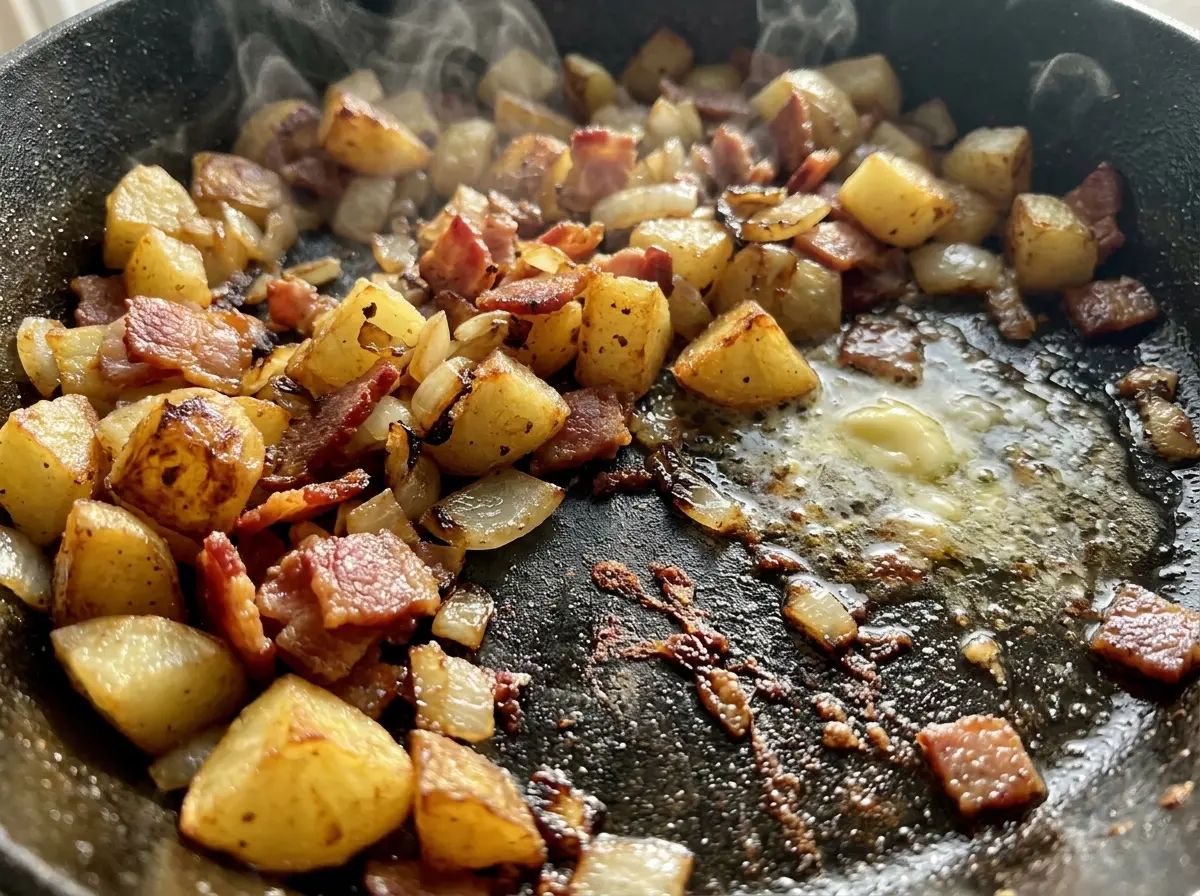
The bacon starts out soft in the skillet, then slowly crisps as its fat collects underneath. I leave those drippings right where they are; they give the potatoes a savory start before the water does its quiet work. These bacon and onion skillet potatoes make a generous side for four, with tender centers and browned edges instead of a panful of potatoes that are crisp outside but still hard in the middle.
The trick is letting the potatoes cook in two distinct phases. A little water and a lid help the cubes turn fork-tender first, while the uncovered finish lets that moisture cook away so the surfaces can brown. I like how the onion softens in the bacon drippings, then joins the potatoes near the end instead of getting lost under the lid. Each bite has a little crispness, a tender center, and bacon and onion tucked through it.
Kitchen Note
I get the most even cooking when every potato cube is close to the same size. Keep them at the half-inch cut; the little pieces can go soft before the larger ones turn fork-tender.
Save these bacon and onion skillet potatoes for the nights you want tender centers with crisp, browned edges.
Why the Covered Stage Comes Before the Crisping
Potatoes need time in contact with moisture to soften all the way through, but moisture is the enemy of a browned surface. Covering the skillet with a small amount of water gives the cubes a steamy, gentle cooking phase. When they’re fork-tender, uncovering the pan gives that water a way to evaporate. Only then can the potato surfaces spend time against the hot skillet and develop crisp spots.
Trying to brown raw potato cubes from the start can leave you choosing between pale, firm centers and dark edges. Here, the covered stage takes care of the centers before the higher-heat finish focuses on color. You don’t need to stir constantly, either; turning the potatoes occasionally gives more surfaces a chance to meet the pan without breaking the cubes apart. Keep the bacon and onion out of the skillet until the finish, so they warm through without getting in the way of the browning.
What the Yukon Golds, Bacon, and Onion Contribute

- Yukon Gold potatoes — Their creamy centers and ability to hold their shape suit this covered-then-crisped method. Choose firm potatoes without soft spots; another similarly waxy potato is the closest stand-in, though the buttery texture won’t be quite the same. Cut them evenly so they finish together.
- Bacon — The rendered drippings carry savory bacon flavor into the potatoes, so ordinary bacon works well here; there’s no need to buy a specialty cut. Cut it into the specified small pieces so it cooks through and crisps in the skillet’s first stage. The bacon returns at the end to warm through.
- Yellow onion — Yellow onion mellows as it cooks and brings a soft, sweet-savory note alongside the bacon. A basic, firm onion is all you need. Another mild cooking onion can stand in, but the finished skillet may taste a little sharper.
- Vegetable oil — The oil helps coat the potatoes along with the bacon drippings, and a standard neutral bottle is fine. If you need to swap it, choose another neutral cooking oil; a strongly flavored oil would change the simple, savory taste.
- Black pepper — Pepper adds a little warmth without taking over the bacon and onion. Freshly ground has a brighter aroma, but preground black pepper works just fine for this skillet.
The Two Heat Stages That Give the Potatoes Tender Centers
Render the bacon until crisp
Set a 12-inch skillet over medium heat and cook the bacon pieces for 8 to 10 minutes, stirring occasionally. They should look crisp rather than bend easily, with rendered fat visible in the pan. If you pull them while they’re still soft, they won’t have the same bite when stirred back in. Transfer the cooked bacon to a plate, leaving the drippings in the skillet.
Soften the onion in the drippings
Add the diced onion to the skillet and cook over medium heat for 4 to 5 minutes, stirring occasionally. Look for softened pieces rather than browned, crunchy edges; the goal is to take away the raw bite. If the onion starts coloring quickly, keep it moving so it softens evenly. Transfer it to the plate with the bacon.
Steam the potatoes until fork-tender
Add the potatoes and vegetable oil to the skillet, season with the kosher salt and black pepper, and stir to coat. Pour in the water, cover the skillet, and cook over medium-low heat for 12 to 15 minutes, stirring once or twice. Keep the lid on between stirs so the steam stays in the pan. The potatoes are ready for the next stage when a fork slides into a cube without resistance.
Uncover and brown the edges
Remove the lid and raise the heat to medium-high. Cook for 8 to 12 minutes, turning the potatoes occasionally, until the water has evaporated and golden, crisp spots have formed. If the pan still looks wet, give the moisture time to cook off before judging the color. Stir the bacon and onion back in during the last 2 minutes, just long enough to heat them through.
Small Changes That Shift the Skillet’s Texture
A bacon-free, vegetarian skillet
Leave out the bacon and cook the diced onion with the potatoes, vegetable oil, and water from the start of the covered stage. The onion will turn soft and sweet, while the potatoes lose the bacon’s savory richness. This keeps the dish vegetarian without adding another ingredient.
Smaller cubes for more browned edges
Cut the potatoes smaller than the usual half-inch cubes for more surface area and a less substantial center. They’ll soften sooner, so check for fork-tenderness during the covered stage and watch the uncovered browning closely rather than waiting automatically for the full time window.
Storage and Reheating
- Refrigerator: Refrigerate leftovers in a shallow, airtight container within 2 hours and use within 3 to 4 days. The crisp edges soften as the potatoes sit.
- Freezer: Freezing isn’t my first choice; thawed potatoes tend to turn mealy, and the crisp texture doesn’t return well.
- Reheating: Warm the potatoes uncovered in a skillet over medium heat, turning occasionally, until they reach 165°F. Covering them traps steam and softens the edges further.
Questions That Come Up While the Potatoes Cook
Bacon and Onion Skillet Potatoes
Ingredients
Equipment
Method
- Cook the bacon in a 12-inch skillet over medium heat for 8 to 10 minutes, stirring occasionally, until crisp.
- Transfer the bacon to a plate and leave the drippings in the skillet.
- Add the onion to the skillet and cook over medium heat for 4 to 5 minutes, stirring occasionally, until softened.
- Transfer the onion to the plate with the bacon.
- Add the potatoes and vegetable oil to the skillet, season with the salt and pepper, and stir to coat.
- Add the water, cover, and cook over medium-low heat for 12 to 15 minutes, stirring once or twice, until the potatoes are fork-tender.
- Uncover and cook over medium-high heat for 8 to 12 minutes, turning the potatoes occasionally, until the water has evaporated and the potatoes are golden and crisp in spots.
- Stir in the bacon and onion during the last 2 minutes.