At the halfway turn, the potatoes should have picked up color on the pan side, while the onion and red pepper are softening around them. That’s the moment I check that the pieces are still spread out instead of piled together. Those browned edges give these Make Ahead Breakfast Bowls their roasted, savory base.
I like that each part cooks in the pan that suits it: potatoes roast on a sheet pan, sausage browns in a skillet, and eggs stay soft in a nonstick pan. Once everything is divided into containers, the bowls are ready for the refrigerator or freezer. They’re a practical way to have a warm breakfast waiting without cooking all three components in the morning.
Kitchen Note
I pull the eggs from the heat as soon as they’re just set, rather than waiting for them to look firm and dry. They’ll be warmed again later, and starting with tender curds keeps the finished bowl from turning tough.
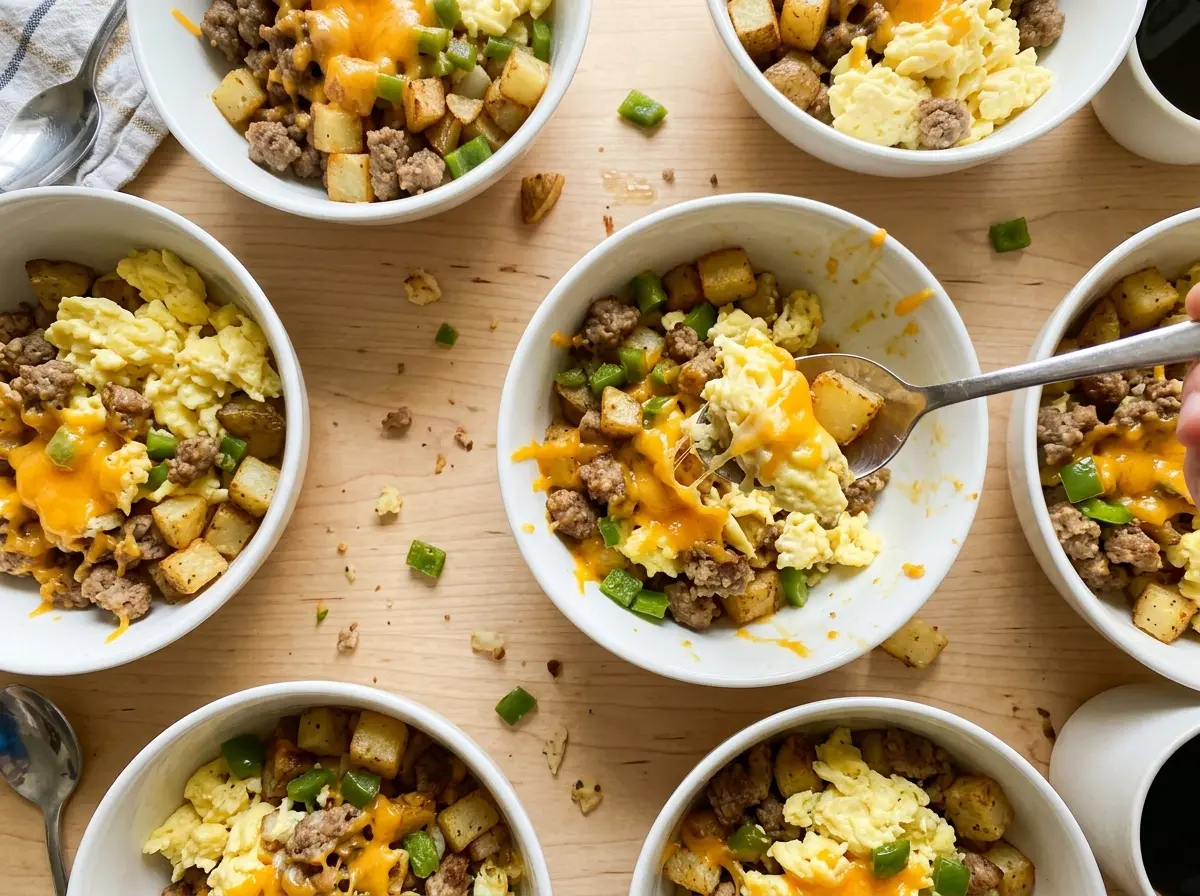
Save these Make Ahead Breakfast Bowls for a week of roasted potatoes, browned sausage, soft eggs, and cheddar ready to warm.
Why These Potatoes Need Room on the 13-by-18-Inch Pan
Roasted potatoes brown when their cut sides have contact with the hot sheet pan. If the pieces are heaped together, steam gets trapped between them and you’re more likely to get soft, pale potatoes than crisp, browned edges. The diced pepper and onion share the pan, so an even layer matters for those vegetables, too.
Cutting the Yukon Golds into 1/2-inch cubes gives them a consistent head start: smaller pieces soften on schedule, while much larger ones can still be firm in the center when the outside has browned. Spread everything across the 13×18-inch rimmed baking sheet, then turn the mixture once halfway through roasting. That single turn brings another side of the potatoes into contact with the pan without breaking up the tender pieces. Look for browned spots and potatoes that yield easily when pierced.
What the Yukon Golds, Sausage, and Cheddar Bring to Each Bowl

- Yukon Gold potatoes — Their creamy centers and sturdy shape suit a bowl that gets stored and reheated. Cut them into even cubes so they roast at the same pace; choose firm potatoes without soft spots.
- Red bell pepper and yellow onion — They roast alongside the potatoes and add sweetness and savory flavor without another cooking pan. Dice them so they’re easy to portion with the potatoes. If you leave out the pepper, the base will have less color and sweetness.
- Olive oil and seasonings — The oil coats the vegetables and helps them roast rather than dry out. Garlic powder gives the potatoes savory flavor without adding chopped garlic that could brown quickly on the sheet pan. Measure the kosher salt and black pepper evenly across the mixture.
- Pork breakfast sausage — It brings a seasoned, savory component that stands apart from the roasted vegetables. Break it into small pieces as it cooks so it’s easy to divide among the bowls. Choose the kind of pork breakfast sausage you like; the recipe uses it as the meat component, not as a seasoning for the eggs.
- Eggs and milk — The eggs provide soft curds, while the milk loosens the mixture as it cooks. Whisk them together before they go into the skillet so the milk is distributed rather than left in streaks. Fresh eggs are a good choice, but there’s no need for a specialty variety.
- Shredded cheddar — Cheddar melts over the warm components and brings a sharp, familiar finish. Freshly shredded cheddar tends to melt more smoothly; packaged shredded cheddar is convenient and works for the topping.
Four Separate Stages Keep the Bowls Balanced
Roast the Potatoes and Vegetables
Heat the oven to 425°F. Toss the cubed potatoes, diced bell pepper, diced onion, olive oil, kosher salt, black pepper, and garlic powder directly on a 13×18-inch rimmed baking sheet, then spread them into an even layer. Roast for 25–30 minutes, turning once halfway through. They’re ready when the potatoes are tender and browned.
Brown the Sausage While the Oven Works
Cook the pork breakfast sausage in a 12-inch skillet over medium heat for 8–10 minutes. Break it into small pieces as it cooks so the crumbles brown throughout instead of staying in a few large chunks. Check that it reaches 160°F, then transfer it to a plate. This timing lets the sausage cook while the potatoes roast.
Scramble the Eggs Gently
Whisk the eggs and milk together in a bowl, then pour them into a 10-inch nonstick skillet over medium-low heat. Stir gently for 5–7 minutes, moving the setting curds through the pan without beating them into tiny pieces. Take them off the heat when they’re just set and have reached 160°F; dry, firm curds have already gone too far for a bowl that will be reheated.
Portion the Components Before Chilling
Divide the potatoes, sausage, and eggs among six 2-cup microwave-safe containers. Scatter the shredded cheddar evenly over the tops so every portion gets some. Let the bowls cool before covering, keeping the cooling period within the stated two-hour limit. Then refrigerate or freeze them according to the storage directions below.
Three Simple Ways to Adapt the Bowls
Make a Meatless Batch
Leave out the pork sausage and divide the roasted potatoes, vegetables, and eggs among the containers. The bowls will be lighter and less savory, but the cheddar still gives each serving a rich finish.
Make the Bowls Dairy-Free
Omit the milk from the eggs and leave off the cheddar; choose pork breakfast sausage with no dairy ingredients. The eggs will be less tender without milk, and you’ll lose the melted cheese topping, but the potatoes and sausage still make a filling bowl.
Leave Out the Red Pepper
Skip the diced bell pepper if you don’t have one or prefer a simpler potato-and-onion base. The bowls will lose some color and sweetness, but the remaining vegetables still roast on the same sheet pan.
Storage and Reheating
- Refrigerator: Store covered bowls for up to 4 days. The potatoes and eggs will soften and firm up a little after chilling.
- Freezer: Freeze the assembled bowls for up to 2 months in microwave-safe containers.
- Reheating: Microwave a refrigerated bowl covered but vented for 1 1/2–2 1/2 minutes, stirring halfway through, until it reaches 165°F. For a frozen bowl, microwave for 4–6 minutes, stirring halfway through, until it reaches 165°F. Don’t seal the cover while microwaving.
Questions That Come Up When Prepping These Bowls
Make Ahead Breakfast Bowls
Ingredients
Equipment
Method
- Preheat the oven to 425°F.
- Toss the potatoes, bell pepper, onion, olive oil, salt, black pepper, and garlic powder on a 13x18-inch rimmed baking sheet and spread into an even layer. Roast for 25–30 minutes, turning once halfway through, until the potatoes are tender and browned.
- While the potatoes roast, cook the sausage in a 12-inch skillet over medium heat for 8–10 minutes, breaking it into small pieces, until browned and cooked to 160°F. Transfer to a plate.
- Whisk the eggs and milk in a bowl.
- Cook the egg mixture in a 10-inch nonstick skillet over medium-low heat for 5–7 minutes, stirring gently, until just set and it reaches 160°F.
- Divide the potatoes, sausage, and eggs among six 2-cup microwave-safe containers and top evenly with the cheddar.
- Let cool no longer than 2 hours before covering. Refrigerate for up to 4 days or freeze for up to 2 months.
- Microwave a refrigerated bowl covered but vented for 1 1/2–2 1/2 minutes, stirring halfway through, until it reaches 165°F. For a frozen bowl, microwave for 4–6 minutes, stirring halfway through, until it reaches 165°F.